-
After Collapse: Modeling U.S. Post-Collapse Futures (2035–2060)
Abstract
This follow-up report simulates what may happen after the collapse of the United States. Using a 25-year Markov model beginning in national fragmentation, the simulation explores five potential trajectories: prolonged division, authoritarian resurgence, foreign control, civil conflict, and national reconstruction. The results suggest that despite the destabilizing effects of collapse, reconstruction is by far the most likely long-term outcome.
Overview
The initial model projected a high likelihood of U.S. collapse by 2035. This report extends the simulation to ask: What comes next? Using a new transition matrix and post-collapse state space, the model simulates how a future United States—or what remains of it—might evolve from 2035 to 2060.
Post-Collapse States Modeled
- Fragmented States – Regional governments or successor nations take control
- Military Rule – A centralized regime emerges to enforce order
- Foreign Influence Zone – External powers assert control over parts of the former U.S.
- Civil War – Competing domestic factions engage in sustained conflict
- Reconstruction – A new national system or federated republic is established
Methodology
We modeled 10,000 simulations over a 25-year horizon (2035–2060). Each simulation began in Fragmented States, the assumed initial state after Total Collapse. Each year, the system transitioned to another state based on predefined probabilities reflecting global and historical post-collapse dynamics.
The model used a Markov process, where each year’s transition depended solely on the current state and transition matrix.
Results
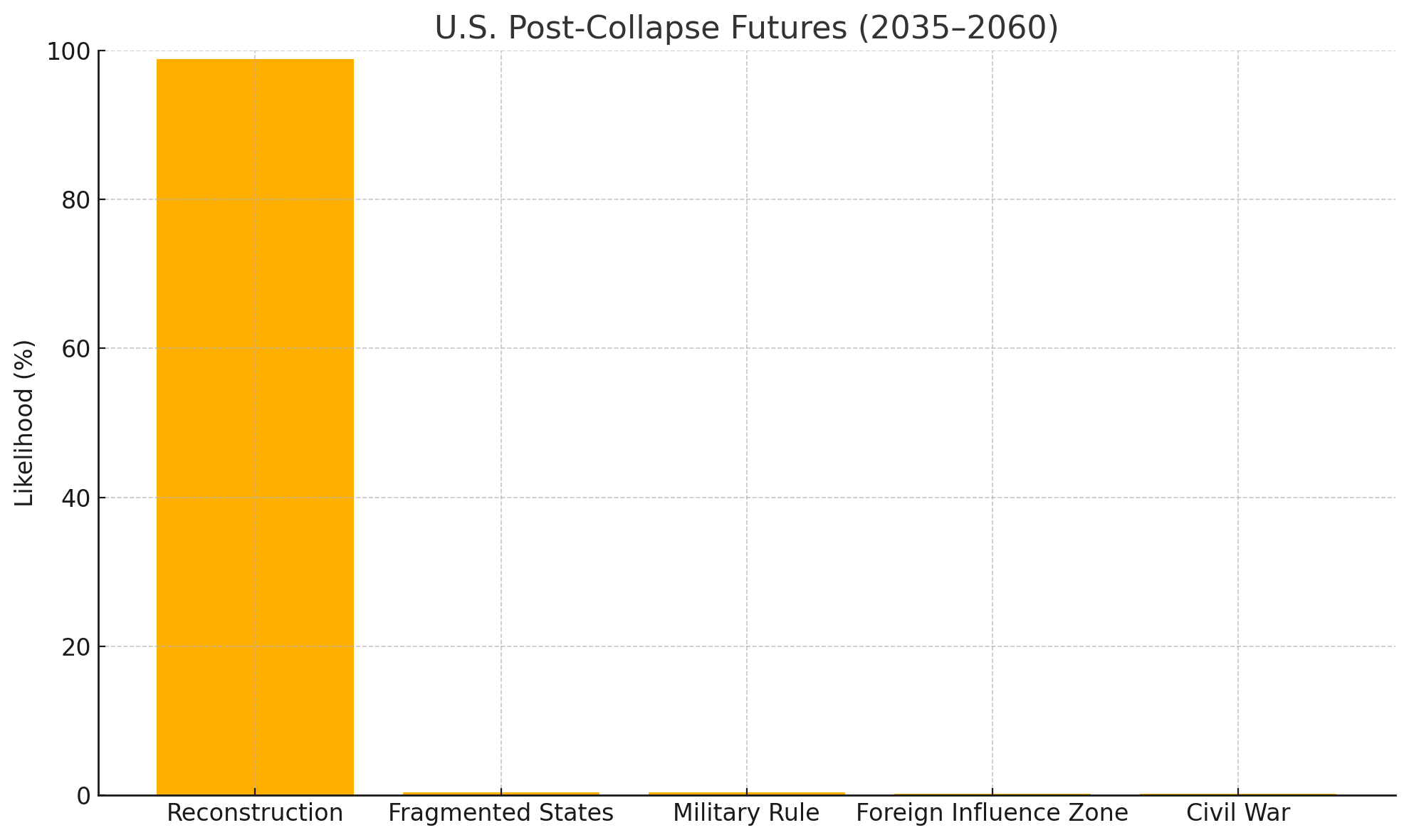
| Final State            | Likelihood (%) |
|------------------------|----------------|
| **Reconstruction**     | 98.8%          |
| Fragmented States      | 0.4%           |
| Military Rule          | 0.4%           |
| Foreign Influence Zone | 0.2%           |
| Civil War              | 0.2%           |
Interpretation
The overwhelming dominance of Reconstruction suggests that even after national collapse, the U.S.—or its successor institutions—tends to rebuild. While regional fragmentation and foreign pressure may occur in the short term, they do not persist. Most paths converge toward some form of national reconstitution.
This could reflect inherent geographic, cultural, or institutional forces that favor reunification after disruption. It may also represent the relative fragility of prolonged foreign control or internal conflict in a large, resource-rich territory.
Conclusion
Collapse is not the end of the story. While the previous model showed collapse as the most probable near-future outcome, this simulation reveals a powerful long-term tendency toward reconstruction. The U.S. may fall—but if it does, it will likely rise again in a new form.
-
Simulating U.S. Futures with Agent-Based Dynamics (2025–2035)
Abstract
This report models the future of the United States using a hybrid simulation that combines Markov state transitions with agent-based influences. Four agents—Civic Movements, Economic Conditions, Government Response, and Private Wealth—interact with the system each year, nudging the nation toward collapse, authoritarianism, reform, or decline. This dynamic simulation reveals how institutional and grassroots forces compete to shape the nation’s trajectory over a 10-year period.
Overview
While traditional forecasting treats national futures as linear or purely systemic, this model adds the behavior of key actors—each with their own momentum and influence. Starting from a state of Adaptive Decline, the simulation explores how national outcomes change when public unrest, economic stress, centralized authority, and private influence are allowed to evolve and respond to conditions over time.
States Modeled
- Total Collapse – Institutional failure, economic breakdown, loss of civil order
- Authoritarian Stability – Centralized control produces stability at liberty’s expense
- Rebellion and Resurgence – Uprising and disruption followed by civic renewal
- Adaptive Decline – Erosion of power, slow reform, and institutional drift
Agents Included
- Civic Movements – Grow in response to decline or authoritarianism, push for renewal
- Economic Conditions – Deteriorate under stress, increase likelihood of collapse
- Government Response – May centralize power or cede control, shaping order vs unrest
- Private Wealth – Entrenches decline or reacts to instability with influence shifts
Each agent independently evolves over time based on the nation’s state and exerts weighted influence over transition probabilities.
Methodology
The simulation runs 10,000 futures from 2025 to 2035. Each year:
- The system updates the state of each agent
- Their influence modifies the base transition matrix
- The nation moves probabilistically to a new state
This hybrid model preserves the Markov foundation while layering in agent-based complexity.
Results
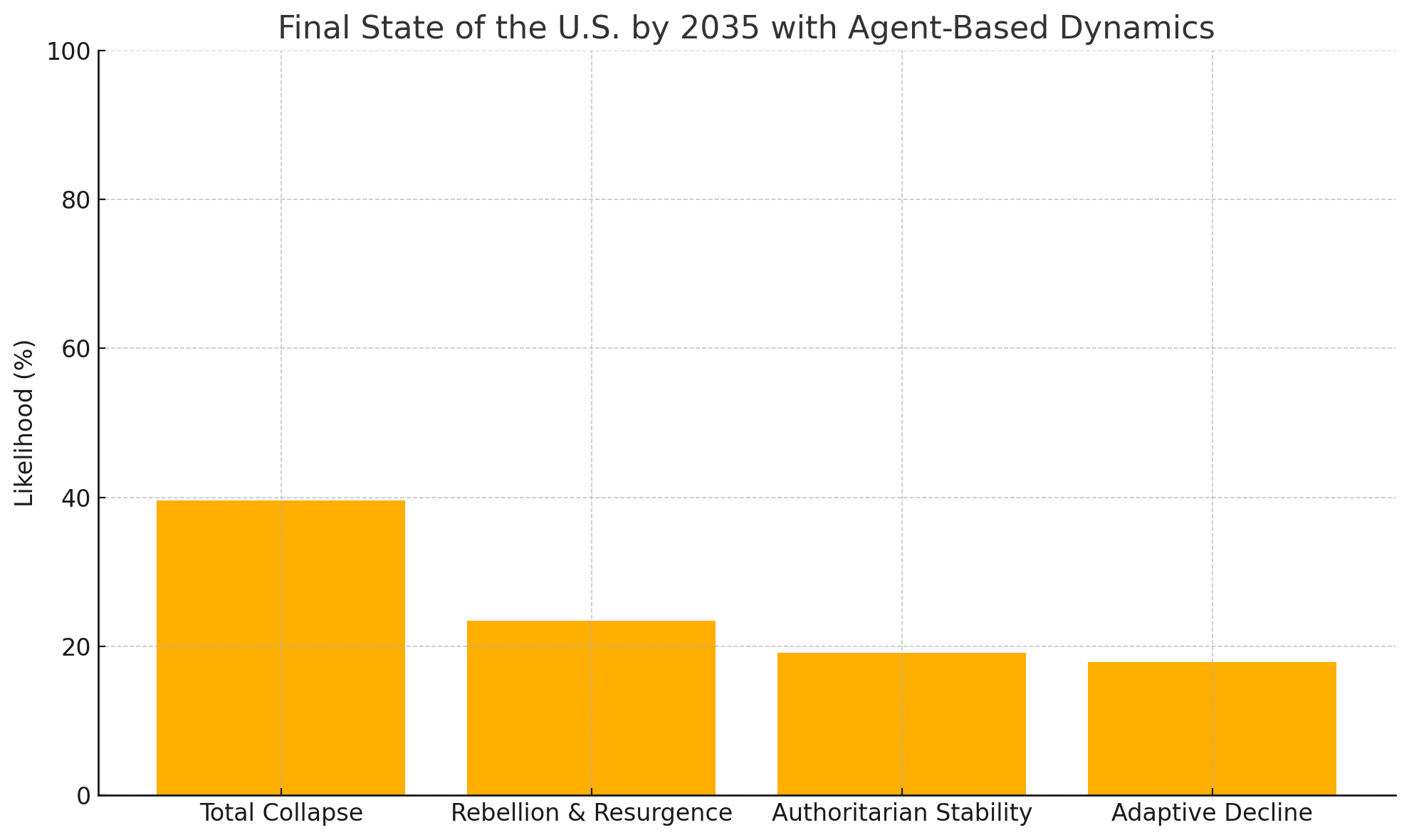
Final State              | Likelihood (%)
-------------------------|----------------
Total Collapse           | 39.6%
Rebellion & Resurgence   | 23.4%
Authoritarian Stability  | 19.1%
Adaptive Decline         | 17.9%
Final States Explained
-
Total Collapse
A breakdown of national function: economic freefall, failed institutions, civil unrest, or potential fragmentation. The federal government loses control, and order deteriorates. -
Authoritarian Stability
The U.S. remains intact and functional, but under increasingly centralized, repressive rule. Freedoms diminish, but chaos is kept at bay through strict control. -
Rebellion and Resurgence
Civic movements and unrest disrupt the existing order, leading to institutional reform or grassroots renewal. Risky but hopeful—disruption gives way to rebirth. -
Adaptive Decline
A slow, hollowing-out of national capacity. The government muddles through with weak reforms, growing inequality, and diminished global standing. Not collapse, but not recovery either.
Interpretation
Systemic collapse remains the dominant risk but the influence of active agents leads to greater volatility and higher odds of civic resurgence. Civic movements counter authoritarian drift. Economic instability and elite entrenchment deepen collapse and erode adaptive stability.
This model demonstrates that even modest behavioral agents can significantly alter future outcomes from pure decay to more dynamic possibilities.
Conclusion
If current dynamics continue, the United States is more likely to collapse than to recover within the next 10 years. The simulation shows that by 2035, the most probable outcome is Total Collapse: the breakdown of governance, economic stability, or national unity. This is the result of thousands of simulated futures shaped by real-world forces.
Adaptive Decline and Authoritarian Stability may delay collapse, but they don’t reverse it. Civic resurgence is possible, but remains a minority outcome, requiring a level of mobilization and reform not currently visible in the system.
This model doesn’t predict the exact date of failure but it does show that, on the current path, collapse isn’t just possible, it’s probable.

-
A Scenario-Based Model of the Simulation Hypothesis
Abstract
This report explores the Simulation Hypothesis using a conceptual framework of possible scenarios. Rather than attempting to calculate definitive probabilities, we present several qualitatively distinct futures to illuminate the conceptual landscape of this philosophical question. We examine different technological, ethical, and structural possibilities that could affect the prevalence and stability of simulated realities. While this analysis cannot determine whether we exist in a simulation, it highlights key factors that shape the internal logic of the hypothesis and its philosophical implications.
Overview
The Simulation Hypothesis suggests that technologically advanced civilizations might create detailed simulated realities indistinguishable from base reality. This report does not aim to prove or disprove this hypothesis, as it is fundamentally metaphysical in nature. Instead, we explore different conceptual scenarios to better understand what conditions might influence the development and stability of such simulations.
Methodological Approach
We have developed a conceptual framework that explores five distinct scenarios representing different possible futures regarding simulation development. We do not claim to calculate precise probabilities. Instead, we qualitatively assess each scenario based on internal consistency, philosophical implications, and conceptual coherence.
Our analysis considers four conceptual states:
- Base Reality – physical existence outside any simulation
- Simulated Reality – direct simulation created by base reality entities
- Nested Simulation – simulations created within other simulations
- Non-Existence – the absence of conscious experience in a particular context
We acknowledge that transitions between these states may not follow simple patterns and could be bidirectional in some cases (e.g., moving between simulated environments or returning to base reality from a simulation).
Computational Considerations
Nested simulations would logically face increasing resource constraints. If each simulation requires substantial resources from its parent reality, then deeply nested simulations would become progressively more difficult to sustain. We discuss these constraints qualitatively rather than attempting to model them with specific mathematical formulas lacking empirical grounding.
Scenario Descriptions
1. Technological Limitation
In this scenario, creating fully immersive, conscious-supporting simulations remains permanently beyond technological reach. While virtual environments may become increasingly sophisticated, they never achieve the complexity necessary to host conscious experiences indistinguishable from base reality.
Key implications: If this scenario holds, we almost certainly exist in base reality, as the alternative would not be possible.
2. Ethical Governance
Advanced civilizations develop the capability to create conscious-hosting simulations but implement strong ethical frameworks limiting their creation and use. Simulations might be created for specific research purposes but are carefully monitored and typically temporary.
Key implications: Under this scenario, simulated existence would be rare and likely purposeful rather than arbitrary.
3. Simulation Proliferation
Simulation technology becomes widespread with minimal restrictions. Advanced civilizations routinely create numerous simulations for various purposes. Both base reality and simulated entities regularly create new simulations, though resource constraints still limit the depth of nesting possible.
Key implications: In this scenario, simulated conscious experiences could significantly outnumber base reality experiences, though stability at deeper nested levels would decline.
4. Technical Instability
Simulations become prevalent but face inherent technical limitations leading to frequent failures, particularly in nested implementations. While creating simulations is common, maintaining them stably over long periods proves challenging.
Key implications: Consciousness might frequently transition between different simulated environments or face termination as simulations collapse.
5. Natural Constraint
The universe (whether base or simulated) contains natural laws that inherently limit computational complexity beyond certain thresholds, preventing deeply nested simulations regardless of technological advancement.
Key implications: This scenario suggests a natural ceiling to simulation depth that applies universally.
Qualitative Assessment
Rather than presenting precise probabilities, we offer qualitative assessments of each scenario:
Technological Limitation
- Plausibility: Moderate to high
- Consistency with current knowledge: High (we currently cannot create conscious simulations)
- Philosophical implication: We almost certainly exist in base reality
Ethical Governance
- Plausibility: Moderate
- Consistency with current knowledge: Unknown (depends on future ethical frameworks)
- Philosophical implication: Simulated existence would be rare but possible
Simulation Proliferation
- Plausibility: Moderate
- Consistency with current knowledge: Unknown (depends on future capabilities)
- Philosophical implication: Simulated existence could be more common than base reality existence
Technical Instability
- Plausibility: Moderate to high
- Consistency with current knowledge: High (complex systems tend to develop instabilities)
- Philosophical implication: Stable simulated existence would be relatively rare
Natural Constraint
- Plausibility: Unknown
- Consistency with current knowledge: Unknown (depends on fundamental limits we may not yet understand)
- Philosophical implication: Universal constraints would apply to all reality levels
Observer Selection Considerations
Any discussion of the Simulation Hypothesis must address observer selection effects—the fact that we can only consider these questions as conscious entities. This introduces significant philosophical complexity that cannot be resolved through simple probability calculations.
The fact that we exist as conscious observers tells us nothing definitive about whether we exist in base reality or a simulation, as consciousness is a prerequisite for asking the question in either case.
Limitations of This Analysis
This framework has several important limitations:
-
Metaphysical nature: The Simulation Hypothesis is fundamentally metaphysical and cannot be empirically tested from within a potential simulation.
-
Conceptual exploration only: Our scenario analysis represents a conceptual exploration rather than a predictive model.
-
Unknown variables: Many relevant factors (future technological capabilities, the nature of consciousness, etc.) remain highly uncertain.
-
Bidirectional possibilities: We acknowledge that transitions between states might be bidirectional in some scenarios.
Relation to Existing Literature
This work builds on Bostrom’s Simulation Argument while avoiding some of its probabilistic assumptions. It also relates to Chalmers' work on digital consciousness and various philosophical treatments of reality and simulation.
We emphasize the qualitative exploration of different possibilities rather than attempting to calculate specific probabilities.
Conclusion
The Simulation Hypothesis remains an intriguing philosophical question that cannot be resolved through probability calculations or scenario modeling. Our analysis suggests several qualitatively different possibilities regarding the development and stability of simulated realities, each with distinct philosophical implications.
Rather than concluding with a probability estimate of whether we live in a simulation, we suggest that the more meaningful questions concern what kinds of simulations might be possible, what constraints they might face, and what ethical considerations might govern their creation and maintenance.
Future work in this area would benefit from deeper philosophical exploration of consciousness, reality, and the ethical dimensions of creating simulated conscious experiences, rather than attempting to calculate precise probabilities for metaphysical propositions.
-
Simulating the Emergence of AGI: A Scenario-Based Projection (2025–2050)
Abstract
This report explores the potential emergence of artificial general intelligence (AGI) using a scenario-based simulation model that incorporates key uncertainties in technology, governance, and capability thresholds. It introduces a decoupled definition of AGI, transparent transition matrices, and integrated technical milestones. Using a six-state lifecycle model and scenario planning combined with Markov simulation, the model examines four global scenarios from 2025 to 2050. AGI is treated as a functional outcome, defined by specific capability thresholds, not end states. Results suggest that AGI emergence is plausible under most modeled conditions, with timelines shaped by governance dynamics and technical progress. This model is a foresight tool and not a predictive forecast.
Methodology
Lifecycle States
The simulation models societal and technological AI integration through six lifecycle states:
- Emergence – early development and curiosity
- Acceleration – rapid expansion and investment
- Normalization – widespread integration and regulation
- Pushback – societal and political resistance
- Domination – AI becomes core to major systems and decisions
- Collapse/Convergence – systemic failure or post-human fusion
AGI Definition
AGI is identified when the system achieves capability-based thresholds:
- Cross-domain generalization
- Autonomous recursive improvement
- Displacement of human decision-makers in core domains
- Widespread cognitive labor substitution
Multiple definitions were modeled to test sensitivity, including narrow (Turing-level equivalence) and broad (global systemic integration) thresholds.
Scenario Framework
The simulation explores four scenario quadrants defined by two uncertainties:
- Technological Trajectory – Slow vs. sudden progress
- Governance Strength – Coordinated vs. fragmented regulation
Scenarios:
- A – Slow, Stable AI: Global regulation strong, AGI emerges slowly (if at all)
- B – Controlled AGI: AGI emerges under coordinated global governance
- C – Unregulated Race: AGI emerges through market-driven acceleration
- D – AGI in Chaos: AGI emerges rapidly with fragmented governance
Transition Matrices
Each scenario uses a unique, published transition matrix with the following:
- Documented assumptions
- Justification from historical trends or expert judgment
- Time-gating on advanced transitions
- Sensitivity analysis showing how outcomes vary with changing probabilities
Technical Track Integration
The simulation incorporates a parallel track modeling technical capability growth, including:
- Hardware scaling (FLOPS, memory bandwidth)
- Algorithmic breakthroughs (efficiency curves)
- Capability evaluations (e.g., ARC, real-world generalization tests)
Transitions into late lifecycle states are conditional on meeting these technical milestones.
Key Findings
AGI Emergence Statistics by Scenario
| Scenario       | Likelihood by 2050 | Avg. Emergence Year | Earliest Emergence |
|----------------|--------------------|----------------------|---------------------|
| Quadrant D     | 95.3%              | Year 6.3             | 2028                |
| Quadrant C     | 91.7%              | Year 8.2             | 2028                |
| Quadrant B     | 81.4%              | Year 10.4            | 2028                |
| Quadrant A     | 59.8%              | Year 13.1            | 2028                |
Results Variability
- Confidence intervals and variance are reported per scenario.
- Pathway analysis reveals dominant transition sequences.
- High variance is observed in fragmented scenarios (C, D).
Scenario Enhancements
- Regional modeling and variable regulatory dynamics
- Additional uncertainty dimensions: public acceptance, economic shocks, ecological instability
- Inclusion of wildcard events (e.g., open-source AGI, cyber sabotage, AI ban treaties)
Revised Definitions of States
Each lifecycle state is linked to observable indicators:
- Emergence: First multi-modal models with cross-domain capabilities
- Acceleration: Doubling of AI investment over five years
- Normalization: Majority of economies adopt formal AI regulation
- Pushback: Documented resistance movements, moratoriums, or bans
- Domination: AI in defense, finance, infrastructure
- Collapse/Convergence: Structural reorganization, post-human integration, or collapse of human-centric governance
Historical Analogies
To contextualize the lifecycle states, we’ve mapped them to historical technological transitions:
- Emergence: Early computers (1940s–1950s), internet formation (1970s–1980s)
- Acceleration: Nuclear arms race (1940s–50s), mobile revolution (2000s)
- Normalization: Electricity and utility regulation (1930s–40s), internet standardization (1990s)
- Pushback: Anti-GMO and privacy activism, open-source movements
- Domination: Global finance digitalization, algorithmic trading, military drones
- Collapse/Convergence: Cold War near-misses, systemic shocks like 2008 financial crisis
These analogies provide a heuristic bridge between past technological integrations and future AI trajectories.
Assumptions & Limitations
The model has several key limitations that may affect its validity:
- Overreliance on abstract state labels: Real-world complexity may not fit neatly into discrete categories.
- Simplified actor modeling: The simulation treats global behavior as homogenous within each scenario, ignoring divergent national or corporate strategies.
- Static governance strength: Scenarios assume fixed levels of coordination over 25 years, which may ignore dynamic responses to crises.
- Absence of model-learning adaptation: Agents do not adjust behavior based on past events or outcomes.
Conclusion
While the simulation remains speculative, it offers a more credible and testable framework for exploring the potential emergence of AGI. The goal is to support structured foresight, not predict exact futures.